
Guide
Weed-spraying records: what you must keep.
If you spray weedkiller or any other plant protection product as part of your work in Great Britain, you must keep a record of each application. Here is what the law says, what the Scottish code and Amenity Assured add, and a record you can copy.
This is a guide, not legal advice. We make landscaping software; we are not the regulator. We have quoted the official sources we used and linked them at the end. Rules and guidance change, so check the HSE pages for the current position, and your certificate or assurance scheme for anything specific to you.
- The rule
- What to put in each record
- Other records
- Certificates, NRoSO and Amenity Assured
- Good habits
- England, Wales, Scotland and Northern Ireland
- Questions
The rule
The HSE says: "By law, all professional users must keep records for at least 3 years of all the pesticides applications they undertake." (HSE, FAQ on the use of pesticides, last updated 13 January 2026.)
The legal basis is Article 67 of Regulation (EC) No 1107/2009 as it applies in the UK. For professional users it says records must be kept for at least 3 years and must include the name of the product, the time and the dose of application, and the area and the crop where it was used. HSE's guidance on the Plant Protection Products (Sustainable Use) Regulations 2012 says record keeping is "aligned with that of all other users" and sets out the same periods: 3 years for professional users, 5 years for producers, suppliers, distributors, importers and exporters.
That is the legal minimum. It does not say what format to use, and the sources we read do not require one; the Scottish code says records "can be written by hand in a book or entered on a computer". Many firms record more than the minimum, as the next section shows.
What to put in each record
Three sources are compared below: the law (Article 67), the suggested record sheet in the Scottish Government's code of practice (Annex F), and the records the BASIS Amenity Assured self-audit asks about. "Not listed" means that source does not name the item, not that it is unimportant.
| Item | The law (Article 67) | Scottish code record sheet (Annex F) | Amenity Assured self-audit (2020) |
|---|---|---|---|
| Product | Name of the product | Product and MAPP or HSE number. List every product when a mixture is applied | Product |
| Date and time | The time of application | Date, start time, finish time, total hours | Date; dates and times |
| Dose and volume | The dose | Dose applied, volume applied, total amount of product used | Dose; water volumes where applicable |
| Where | The area and the crop | Site treated; crop, area, material or structure treated; total area treated | Area; location |
| Who | Not listed | Worker's name; job reference | Operators |
| Weather | Not listed | Weather conditions, such as wind speed and direction | Weather conditions at the time of spraying |
| Why | Not listed | Reason for treatment | Not listed |
| Equipment | Not listed | Not listed | Application method and nozzle choice; calibration and maintenance as written records |
| Other | Not listed | Restricted access or ventilation, whether neighbours or beekeepers were told, warning signs put up and taken down, problems | Not listed |
Is the Scottish code current? It is the code the Scottish Government still publishes for Scotland: its gov.scot publication page, checked 3 November 2026, shows "Published 17 January 2007" and lists no newer version. It is old. Section 6.3 says "Other professional users will need to keep records of applications in the future. You should keep these records now as part of good practice", which has been overtaken by the legal requirement above. HSE's guidance (updated 7 October 2025) says new codes "may be issued in due course", that in the meantime the general guidance in the existing codes "remains appropriate", and that where a code is inconsistent with the HSE guidance, "the advice in this guidance takes precedence". The code describes Annex F as a suggested record sheet you can adapt. Follow the HSE where the two differ.
Other records worth keeping
The Scottish code's table of records and how long to keep them lists these, among others. The retention periods are the code's, so check them against current HSE guidance.
- LERAP evidence (Local Environment Risk Assessment for Pesticides, for spraying near water): three years.
- COSHH and environmental risk assessments: until revised.
- Maintenance of exposure controls such as respiratory protective equipment: five years.
- Health surveillance results: forty years.
- Pesticide store records: a current list of what is in store.
- Special waste consignment notes: at least three years.
Certificates, NRoSO and Amenity Assured
Certificates. HSE's guidance on the 2012 regulations says users of professional products must hold a certificate showing sufficient knowledge, and that purchasers must ensure the product will be used by a certificate holder or by a trainee under direct supervision. The Regulations came into force on 18 July 2012.
NRoSO. The National Register of Sprayer Operators, formed in 2003, describes itself as "a central register of sprayer operators using Continuing Professional Development (CPD) as a means of ensuring ongoing training". Its website footer is copyright BASIS Registration Ltd.
Amenity Assured. A BASIS scheme for amenity contractors who provide professional pesticide services, for example to local authorities and industry. It is an annual assessment in two parts: a self-audit covering documentation, equipment, and staff qualifications and ongoing training, and a visit from the independent BASIS auditing team. The 2020 self-audit lists records of area, product, dose, date, operators and weather, and written records of calibration and maintenance. It is aimed at contractors serving local authorities and the industrial, utility and environmental sectors, so clients in those sectors may ask for it. The Amenity Forum's Amenity Standard says organisations can claim adherence only by showing compliance through recognised assurance schemes.
Good habits
- Record on the day, at the site. Records written up later from memory are the weak point in any audit.
- Never overwrite. If an entry is wrong, add a correction that says what it corrects, and keep the original.
- Use the full product name and the MAPP number. The number identifies the exact product.
- Note the conditions. Wind, temperature, rain forecast. If something goes wrong, that is what you will be asked.
- Record who was told. Neighbours, residents, and any signs put up.
- Keep them for at least three years, and longer if a client or scheme asks.
- Be able to produce a customer's diary quickly. A council contract or a worried homeowner will ask.
England, Wales, Scotland and Northern Ireland
The sources above are for Great Britain, with Scotland's own code of practice (the HSE's guidance says its codes are for England and Wales). Northern Ireland is separate: the Department of Agriculture, Environment and Rural Affairs says that from 1 January 2026 professional users there must follow new rules on the content and format of pesticide usage records. We did not find an equivalent change in the HSE pages we read, but check the HSE's current guidance.
Doing this in EasyUse
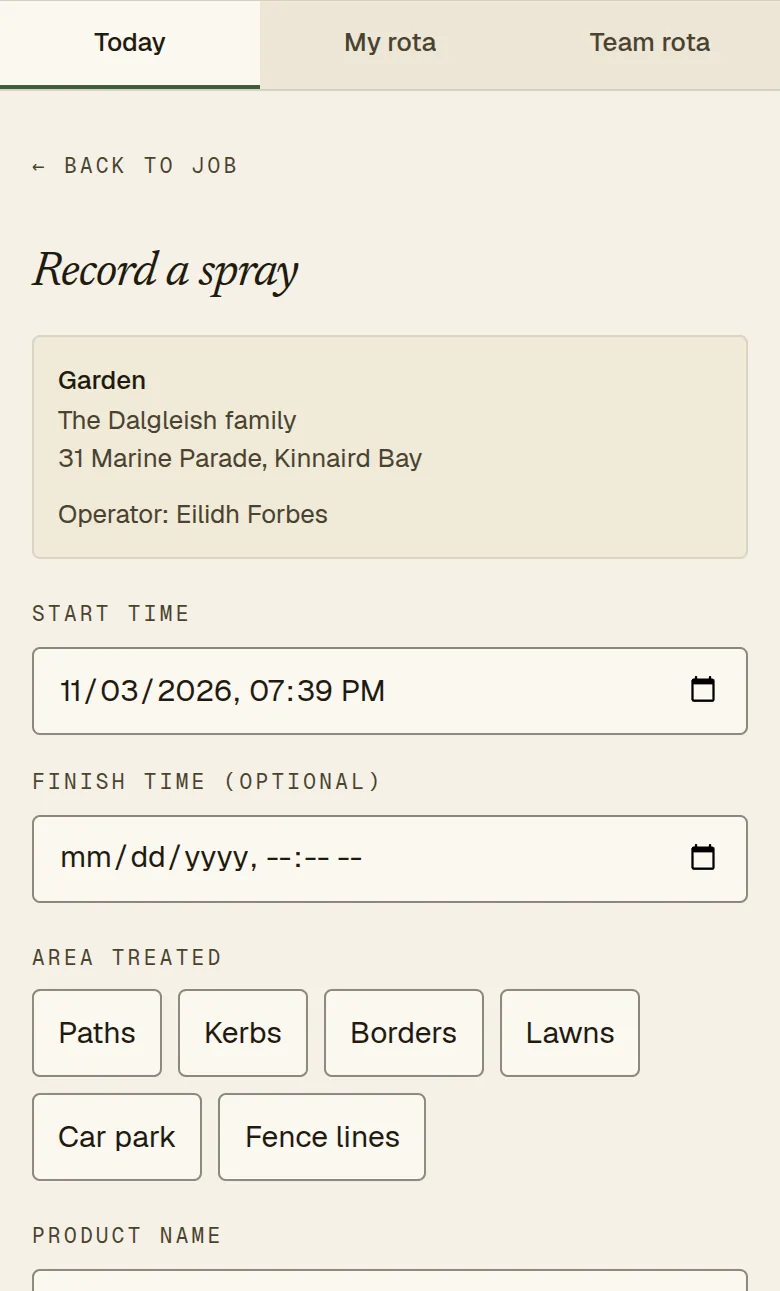
EasyUse has a weed-spraying diary. Crew record each application on their phone from the job, even without signal: it is saved on the phone and sent when it is back online. Each record holds the start and finish time, areas treated, product name, MAPP number, active ingredient, target weed, application rate, total product and water, equipment, weather, temperature, wind, PPE worn, whether warning signs were used and residents told, re-entry advice and the operator's confirmation. The office keeps a per-customer diary and prints it. Corrections are added as new entries and never overwrite the original.
It is a record-keeping tool. It does not replace your certificate, your risk assessments, or your own check that a product is approved for the use. Some features are switched on firm by firm; we will say which when we talk. See the features page, the live demo (made-up data), or how the free pilot works.
Questions
How long must I keep weed-spraying records?
At least 3 years, for professional users, according to the HSE. A client or assurance scheme may ask for longer.
What must a spray record contain?
At a minimum: the name of the product, the time and dose of application, and the area and crop where it was used. Most firms also record the operator, weather, equipment and the MAPP number. The table above compares the sources.
Do landscapers need spray records?
If you use plant protection products in your work, such as a herbicide on paths, drives or borders for customers, the HSE's rule is that professional users keep records. If you are unsure whether you count, ask the HSE.
Can I keep spray records on a phone?
The sources we read do not say a particular format is required, and the Scottish code (2007) says records "can be written by hand in a book or entered on a computer". What matters is that the record is complete, made at the time, kept for the full period and can be produced when asked.
What is a spray diary?
It is the running record of every application, usually kept per customer or site. The Scottish code's record sheet is a good model for the columns.
What is Amenity Assured?
A BASIS assurance scheme for amenity pesticide contractors, with a self-audit and an independent on-site check each year.
Sources and date checked
- HSE, FAQ on concerns about the use of pesticides, updated 13 January 2026: hse.gov.uk.
- HSE, Guidance on the requirements of the Plant Protection Products (Sustainable Use) Regulations 2012, updated 7 October 2025: hse.gov.uk.
- Regulation (EC) No 1107/2009, Article 67, record-keeping, as it applies in the UK: legislation.gov.uk.
- Scottish Government, Pesticides: code of practice for using plant protection products in Scotland (published 17 January 2007; no newer version listed when checked 3 November 2026), section 6, keeping records and Annex F, record sheet for pesticide treatments.
- BASIS, Amenity Assured scheme and Amenity Assured self-audit (2020, PDF).
- NRoSO and the Amenity Forum's Amenity Standard.
- Northern Ireland: DAERA, Operator responsibilities regarding pesticides.
Related: Garden maintenance contracts, Crew time tracking.
Try it on your own firm
Free for 60 days, then £15 a month.
Read what is built on the features page, click around the live demo (made-up data), or see how the free pilot works.