
Guide
How to price landscaping jobs.
A method you can repeat for any quote: add up what the job costs you, add your overheads, then add the profit you need. With a worked example you can copy into your own spreadsheet.
The numbers in the example are made up to show the method. They are not market rates and they are not any real firm's figures. Use your own materials prices, wage costs and overheads.
- The method
- Worked example: a patio
- Markup is not margin
- What an overrun costs
- VAT
- Sense checks before you send it
- Questions
The method
Whether you are asking how to price a landscaping job, a garden clearance or a lawn renovation, the build-up is the same.
- Materials, with an allowance for wastage and delivery.
- Labour: the hours the job will take, multiplied by what an hour of that person really costs you (wages plus employer's National Insurance, pension, holiday pay, training and protective kit), not just their pay rate.
- Plant and hire: diggers, compactors, skips, tip fees.
- Overheads: the costs of running the business that no single job pays for, such as the van, insurance, tools, phone, accounts and software. Share them out across the hours you work, so each job carries its part.
- Profit: what you need left over after all of the above, as a percentage of the price.
- VAT, if you are registered.
Hours are the number most likely to be wrong, so write down how you got them: who, for how many days, doing what.
Worked example: a 20 square metre patio
A customer wants a sandstone patio of 20 m². We assume the ground is straightforward, the paving is delivered, and two people take two and a half days.
| Line | How it is worked out | Cost |
|---|---|---|
| Paving | 20 m² plus 10% wastage = 22 m², at £48 a m² | £1,056 |
| Sub-base, sand and cement | Allowance | £180 |
| Skip for spoil | Allowance | £260 |
| Delivery | Allowance | £60 |
| Labour | 2 people, 2.5 days, 8 hours = 40 person-hours, at £19 an hour fully loaded cost | £760 |
| Plant hire | Mini digger and compactor | £150 |
| Direct cost | Sum of the lines above | £2,466 |
| Overheads | 40 person-hours at £6 an hour | £240 |
| Total cost | Direct cost plus overheads | £2,706 |
| Price for 25% profit | £2,706 divided by (1 minus 0.25) | £3,608 |
| Quote, rounded | Round to a clean figure | £3,600 |
| VAT at 20% | If you are VAT registered | £720 |
| Total to the customer | Quote plus VAT | £4,320 |
At £3,608 the profit is £902, which is 25% of the price. The figure per square metre is £180.40 before rounding. That is a useful sense check against jobs you have done before, but it is not a rate to copy: yours depends on your costs and the ground.
Markup is not margin
This is the most common slip. If you add 25% to your cost of £2,706 you get £3,382.50. Your profit is £676.50, which is 20% of the price, not 25%. To make 25% of the price, divide the cost by 0.75, as above. Decide which one you mean, and use the same one every time.
What an overrun costs
Suppose the patio takes 10 more person-hours than you allowed, because of a drainage surprise. The labour is £19 an hour, and the hour also uses up £6 of overhead recovery on time you cannot bill elsewhere, so each hour costs £25 on this method and the overrun costs £250. Profit falls from £902 to £652, which is 18.1% of the £3,608 price. Ten hours turned a 25% margin into 18%.
That is the case for writing down your hours estimate, and for recording real hours against each job so the next estimate is better. See crew time tracking for landscapers. If the extra work was the customer's change, price it as an extra before you do it.
VAT
You must register for VAT if your taxable turnover for the last 12 months goes over £90,000, according to GOV.UK (checked 3 November 2026). Below that, registering is optional. Whether you are registered changes how you show a price to a customer: a private householder cannot reclaim VAT, so a VAT-registered firm's price for a domestic customer is effectively 20% higher than the same price from a firm that is not registered. Check the details for your own case with your accountant.
Sense checks before you send it
- Is there a line for waste removal and tip fees?
- Does the quote say what is not included, such as ground that turns out to be hard, underground services, or extras the customer asks for later?
- Is the price per square metre, or per day, in line with the last few similar jobs you did?
- How long is the quote valid, given that material prices move?
- Can you start within the time you have said?
Doing this in EasyUse
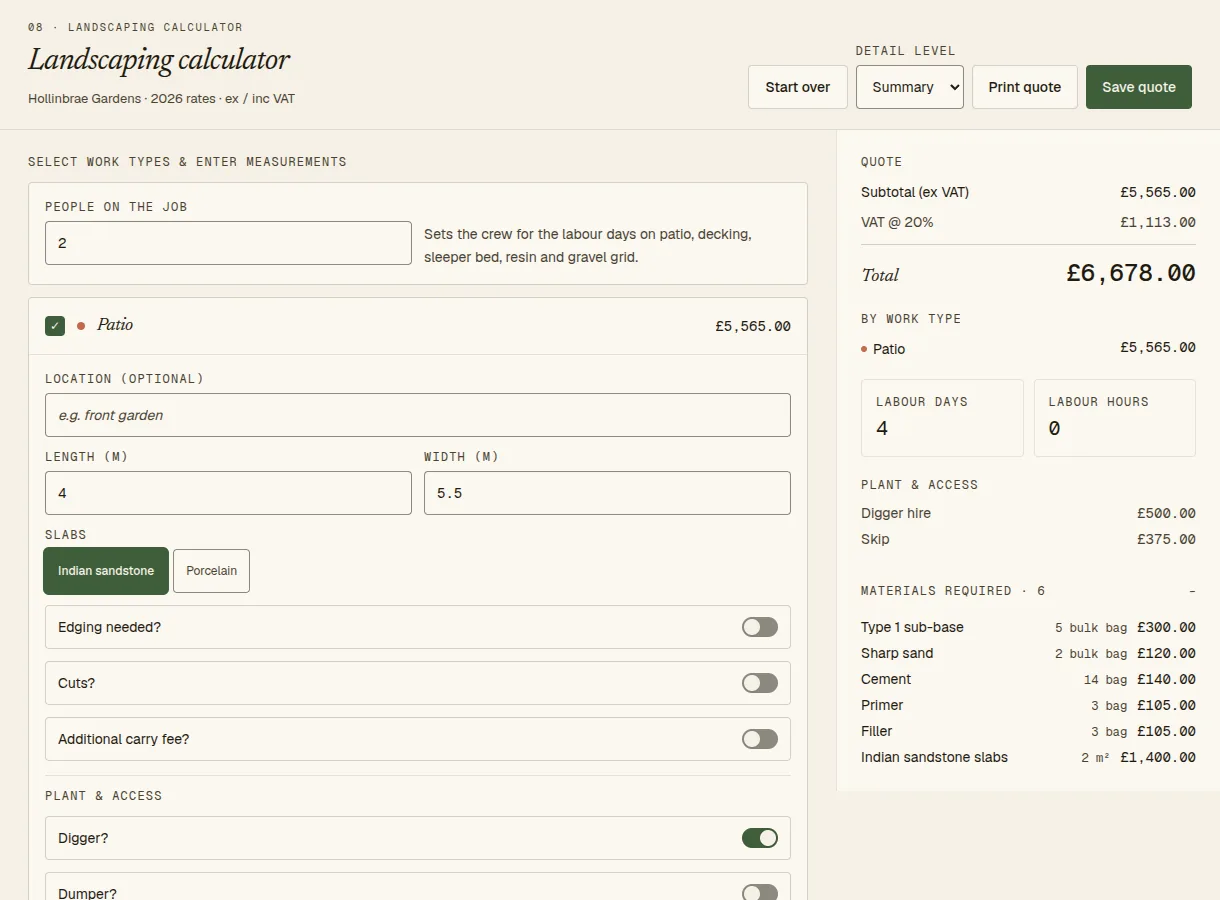
EasyUse prices landscaping trades and garden-maintenance agreements from a rate card you set, rather than building each quote up line by line, and works out totals on the server in pounds so they match every time. The method on this page is how you decide what goes into that rate card. Accepting a quote creates the piece of work that is scheduled and followed to the end. See the features page or try the live demo (made-up data).
Questions
How do I price a landscaping job if I am just starting out?
Use the method above with honest hours and your real costs, even if the answer looks high. Underpricing early is hard to undo. Then compare the result with a few similar local quotes.
Should I charge by the hour, the day or the job?
Customers usually want a fixed price for a project. Hourly or day rates suit small repairs and uncertain work. Whichever you quote, work out the fixed price first so you know what the job really needs.
How much should I charge per hour?
It depends on your costs, so we have not given a figure. Work out the fully loaded cost of an hour (wages and on-costs), add your overhead per hour, then add the profit you need. The example above does this.
How do I price garden maintenance?
Price a single visit by the time it takes and then spread an annual total across the year. See garden maintenance contracts: how to schedule and bill them.
Sources
- VAT registration threshold: gov.uk/vat-registration/when-to-register, checked 3 November 2026.
Related: Garden maintenance contracts, Crew time tracking, EasyUse vs spreadsheets.
Try it on your own firm
Free for 60 days, then £15 a month.
Read what is built on the features page, click around the live demo (made-up data), or see how the free pilot works.